There's something curious about the way people approach design. They want answers before they've understood the questions. They want colours before they've discovered meaning. They want a logo before they've understood the business it represents.
You want to know why so much design feels empty? Because people are trying to solve problems they haven't taken the time to understand.
Good design doesn't begin with creativity alone. It begins with curiosity. With the willingness to look beyond the obvious, to challenge assumptions, to ask the questions that others overlook.
Because before you can create something meaningful, you must first understand what you're creating.
The Courage to Ask Why
Imagine someone approaches you and asks for a logo. They tell you they want something modern, minimal, something that feels premium. They show you a collection of references, point to a few colours they like, and explain that their competitors all seem to be doing something similar.
Where do you begin?
Most designers begin designing. They open their software, gather inspiration, experiment with shapes, and start exploring possibilities. It feels productive. Something is happening. Ideas are taking form.
But stop for a moment.
Why do they need a new logo? What does modern actually mean to them? Why premium? Who are their competitors, and should they even be looking at them? What problem are they trying to solve?
These are the questions that matter. Yet they're often the questions that never get asked.
You see, the brief is rarely the whole story. It's simply the starting point of a conversation. What a client asks for and what a business actually needs can be two very different things.
A new logo might not solve a problem rooted in poor positioning. A refreshed colour palette won't fix a brand that doesn't understand its audience. And no amount of visual sophistication can compensate for a business that has nothing meaningful to say.
The designer's responsibility isn't simply to deliver what has been requested. It's to understand why it has been requested in the first place.
Sometimes, the most valuable thing you can do at the beginning of a project is resist the urge to create.
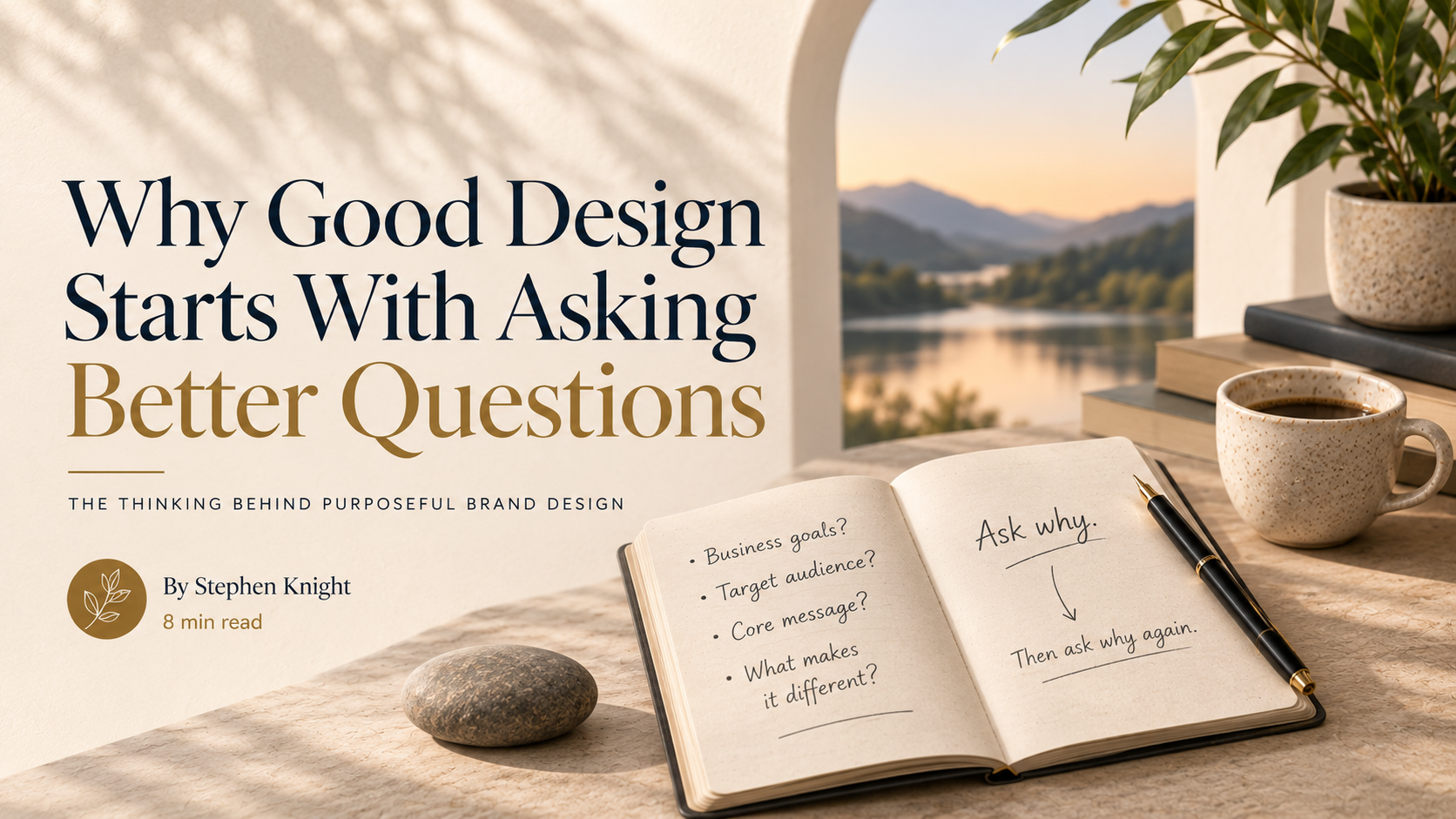
Ask why. Then ask why again.
Understanding Before Creating
Every brand exists for a reason. Somewhere beneath the products, the services, the marketing, and the carefully constructed image, there's a business trying to achieve something.
But understanding that something takes work.
What does the business believe in? What does it want to change? What does it offer that others cannot, or do not, offer in quite the same way? Where does it want to go, and what is preventing it from getting there?
These questions aren't administrative formalities to get through before the exciting part begins. They are the beginning of the exciting part.
Because the more you understand a business, the more possibilities you begin to see.
A company might describe itself as innovative, but innovation is a word that appears in almost every industry. What does it actually do differently? Perhaps it makes complicated things simple. Perhaps it challenges an outdated way of working. Perhaps it gives people access to something they previously couldn't reach.
Now we're getting somewhere.
We've moved beyond a word that sounds good in a presentation and started uncovering something real. Something that can influence how the brand speaks, how it looks, and how it makes people feel.
This is the difference between describing a brand and understanding it.
One tells you what a business wants people to believe. The other helps you discover what makes that belief credible.
And as a designer, you must learn to recognise the difference.
The People on the Other Side
There's another question that should sit at the heart of every branding project.
Who is this actually for?
It's surprisingly easy to forget that a brand isn't created for the person designing it. It isn't created to impress other designers, collect admiration on social media, or win approval from people who will never become its customers.
It's created for people.
Real people with expectations, frustrations, habits, needs, and lives that continue long after they've scrolled past your carefully considered visual identity.
If you don't understand those people, how can you expect to communicate with them?
You can't simply assume that what appeals to you will appeal to them. You can't decide that a particular aesthetic feels trustworthy without considering what trust means to the people you're trying to reach.
For one audience, trust might come from clarity and simplicity. For another, it might come from expertise, familiarity, or the reassurance of a long-established reputation.
The same visual language doesn't speak to everyone in the same way.
This is why research matters. Conversations, observations, customer feedback, and an understanding of the market can reveal things that intuition alone might miss.
Perhaps your audience isn't looking for the most sophisticated solution. Perhaps they're looking for the least intimidating one. Perhaps what they value most isn't the product itself, but the confidence that comes with knowing they've made the right choice.
These discoveries can change everything.
They can challenge your assumptions, reshape your direction, and reveal opportunities you would never have found by looking at a mood board.
Design is a form of communication. And communication begins with understanding who you're speaking to.
The Danger of Designing for Yourself
We all have preferences. Certain colours draw our attention. Particular typefaces feel right. Certain styles excite us in ways others don't.
There's nothing wrong with that. Taste is part of being a designer.
But taste without purpose can become a trap.
I've always believed that one of the hardest things a designer must learn is the difference between what they like and what the project needs.
They're not always the same thing.
You might love minimalist design, but does minimalism express the character of this particular brand? You might be drawn to muted colours and understated typography, but would that help the business stand out in a market dominated by similar identities? You might admire a clever, abstract symbol, but will the intended audience understand anything meaningful from it?
These are uncomfortable questions because they ask us to put our preferences aside.
And that's precisely the point.
Your job isn't to impose your personal aesthetic on every business you work with. Your job is to discover the visual language that makes sense for the business you're designing for.
Sometimes that will align perfectly with your instincts. Sometimes it will challenge them completely.
Both are valuable.
The moment you stop asking whether a design is right for the problem and start asking only whether you like it, you've lost sight of your responsibility as a designer.
Taste can guide you. Experience can inform you. Intuition can lead you somewhere unexpected.
But understanding must give those things direction.
Research Is Not a Detour
People sometimes treat research as the part of the process that happens before the real work begins.
First, we do the research. Then we get to design.
I think this misses something important.
Research is design work. It simply operates in a different form.
When you study competitors, you're not looking for visual references to reproduce. You're trying to understand the landscape. What conventions dominate the industry? What expectations have customers developed? Where does everyone sound the same? Where are the opportunities to do something different?
When you speak to customers, you're not just collecting opinions. You're trying to understand their experiences, their motivations, and the things that influence their decisions.
When you examine a business's history, values, and ambitions, you're looking for the ideas that can give its identity depth and meaning.
All of this is creative work, even when you're not producing anything visual.
In fact, some of the most important creative decisions happen during this stage, long before a logo takes shape or a colour palette begins to emerge.
An insight can be more valuable than a hundred visual references.
Because references show you what something looks like. Insights help you understand why something might need to look different.
And if you want to create brands that stand apart, you must be willing to look beyond what already exists.
When Strategy Becomes Visual
Eventually, the questions begin to lead somewhere.
You understand the business. You have a clearer picture of its audience. You've identified its values, its ambitions, its challenges, and the opportunities that might set it apart.
Now you can begin to design.
Not because you've completed a checklist, but because you finally have something meaningful to work with.
The strategy becomes a foundation for the creative process. It doesn't dictate every decision, and it certainly doesn't eliminate experimentation. Instead, it gives your ideas somewhere to come from and something to work towards.
Perhaps the business needs to communicate authority without appearing intimidating. That understanding might influence the balance between typography, colour, composition, and tone of voice.
Perhaps the audience values warmth and human connection in an industry that feels cold and impersonal. That insight might lead to a visual identity that challenges established conventions.
Perhaps the business has grown beyond the identity it started with. Its original visual language might communicate where it came from, but not where it's going.
Each situation presents a different problem. Each problem demands a different response.
There is no universal formula for good design because there is no universal brand.
This is where creativity becomes powerful. Not when it operates without direction, but when it finds an unexpected way to express something true.
The strategy gives you the reason. The design gives that reason a form.
And when the two work together, the result feels less like decoration and more like an expression of something that was waiting to be understood.
The Beauty of a Clear Direction
There's a particular satisfaction in finding the right solution to a design problem.
It's the moment when the unnecessary falls away. When an idea that once felt complicated becomes simple. When the visual language, the message, and the purpose begin to feel as though they belong together.
But that clarity rarely appears out of nowhere.
It comes from the questions you've asked, the assumptions you've challenged, and the possibilities you've been willing to explore and reject.
It comes from understanding what matters enough to recognise what doesn't.
Without that process, simplicity can become superficial. A designer removes elements because minimalism is fashionable, rather than because those elements serve no meaningful purpose.
But true simplicity is different.
It isn't about having less for the sake of having less. It's about understanding something so clearly that you know what needs to remain.
And you cannot arrive at that clarity by skipping the difficult questions.
The strongest design solutions often look obvious in hindsight. Their simplicity can make you wonder why nobody thought of them before.
But that apparent inevitability is earned. It's the result of looking closely, thinking carefully, and refusing to settle for the first answer that feels comfortable.
Good design doesn't always announce how much thought went into it.
Sometimes, the more deeply you've understood the problem, the less you need to say.
What Better Questions Teach Us
The longer you spend working with brands, the more you realise that design is as much about what you choose not to do as what you choose to create.
Not every idea deserves to become a concept. Not every trend deserves to be followed. Not every client preference should determine the direction of a project.
Sometimes, the most important decision is to step back and question the direction itself.
Are we solving the right problem? Have we understood the audience? Does this idea express something meaningful, or does it simply look good? Are we making decisions based on insight, or are we making assumptions because they are easier?
These questions require honesty.
They ask us to acknowledge what we don't know, to challenge what we think we know, and to remain open to the possibility that the right answer might be different from the one we expected.
That takes discipline. It also takes humility.
You must be willing to listen before speaking, investigate before deciding, and understand before creating.
Because being a good designer isn't about having an immediate answer to every question.
It's about knowing which questions are worth asking.
The Path Forward
If you want to create brands that matter, don't begin by asking what they should look like.
Begin by asking what they need to mean.
Understand the business before trying to express it. Understand the people before trying to communicate with them. Understand the problem before attempting to solve it.
Question the obvious. Challenge the assumptions. Look beyond the first answer, because the first answer is often the easiest one, not necessarily the right one.
Give yourself permission to spend time exploring a problem before rushing towards a solution. Listen to the people involved. Research the world the brand exists in. Look for the contradictions, the overlooked details, the small truths that reveal something bigger.
Then, when you finally sit down to design, you'll have more than inspiration.
You'll have direction.
And direction changes everything.
Because brand design has never really been about making things look beautiful. Beauty matters, of course, but beauty without meaning is only surface.
The real work is discovering what deserves to be expressed, understanding why it matters, and finding the most meaningful way to bring it to life.
That is where good design begins.
Not with a sketch. Not with a screen. Not with a colour palette or a clever idea.
With a question.
And the courage to keep asking until you find an answer worth designing for.